About The Books
A Book by Robert Silhol
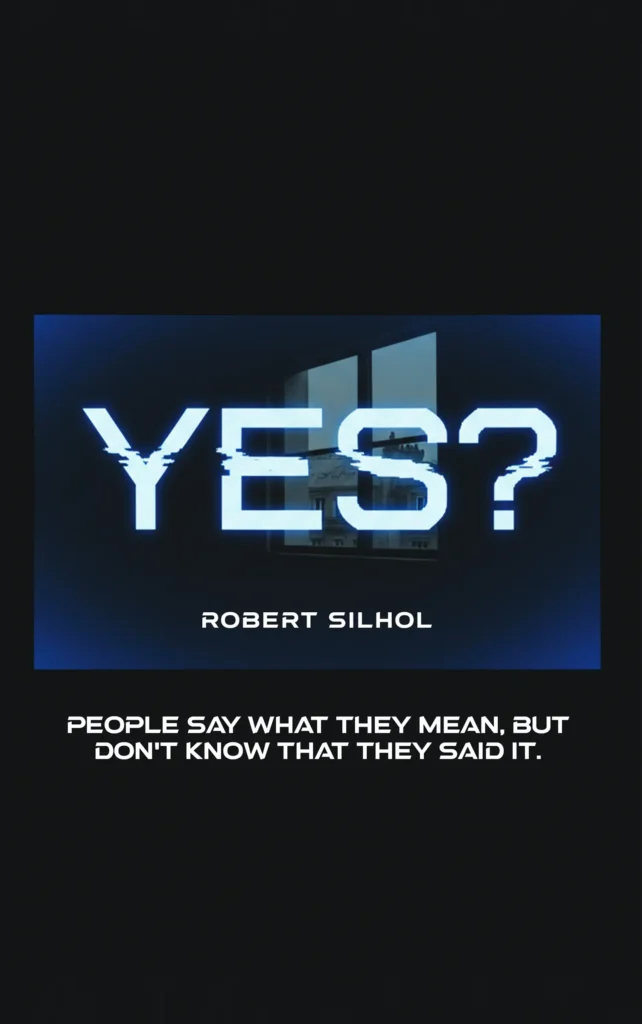
YES?
People say what they mean, but don’t know that they said it
provides a clue to one of the intertwined narratives in the book, given the author’s expertise in Lacanian psychoanalysis. The other narrative is the “science fiction” story, which is also a kind of political fiction in the “post-Truth” era many people argue we are currently living in.
The subtitle is about speech and (mis)communication, but it also reminds me of Slavoj Zizek’s statement about desire: “We don’t really want to get what we think we want” (i.e., in the book, a “meaningful, honest response” from the author (s) of the mysterious computer messages). In other words, “Be careful for what you wish for, you might get it!” Throughout the story, the scientists and the government repeatedly don’t seem to know what they are saying to ‘the machine’ (the Lacanian ‘Thing’?, p. 28) as much as they don’t seem to know what they want from the author(s) of the messages.
JeanPhilippe Mathy
Professor Emeritus of French Studies and Comparative Literature, University of Illinois
The “paradox” (the word keeps coming up in the text) is between what the characters (including the “extraterrestrials,” if that’s what they are) say and what they mean (i.e., speech), on the one hand, and the tension between what they want and what they need (i.e., desire), on the other. The short reference to the author on page 113 refers to both speech and desire: “What people want is often in conflict with what they need; all desire is unconsciously kept just out of reach.”
The second subtext that interested me is the role the government/authorities play in reacting to the possible (symbolic) threat from the computer messages and the (real) ecological catastrophe described in the last pages. This is classic science-fiction stuff, except that the reader is left unsure whether there is a causal link between the message (YOU ARE DESTROYING YOURSELVES!) and the actual planetary crisis.
I can’t help reading the final battle between the scientists who have been seeking a rational explanation through technology and the “special and secret unit of the Crisis Cabinet set up to control and deny whatever would be sent by the Other Planet” through the lenses of the current debates over technology (AI, SpaceX, “accelerationism, TikTok, etc.) as either a threat to or the only solution to the growing political, economic and environmental crises the media (represented by the journalist Marie in the book) keep telling us we are facing.

Reflections from Readers
Reader Perspectives on YES?
Imagine a world where extraterrestrial contact begins not with spaceships, but with cryptic messages appearing on our computer screen. Robert Silhol's YES?, a Syfy mystery novella, plunges readers into an extended Twilight Zone-esque scenario in contemporary France. The question ultimately is not 'Who are these aliens?' but 'How will humanity respond?' This dialogue-driven story exposes the full spectrum of human vulnerabilities, from our deepest insecurities to our irrational impulses.
In a time of "life coaches" and goal setting, the need to "Decide what you want" and then go after it, is familiar, contemporary injunction. As though it were so easy to identify what we want. This is the philosophical source of Robert Silhol's fiction in a world easily recognizable as our own. For as we approach our desire, shame, horror and anxiety quickly invade the picture.
Robert Silhol has spent much of his career lecturing, advising, and championing the teachings of Jacques Lacan. In this work, he once again offers an engaging and insightful perspective on the French psychiatrist often hailed as "the most controversial psychoanalyst since Freud.”